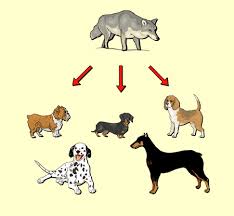
"Artificial selection has resulted in plants that are more disease-resistant, cows that produce more milk, and racehorses that run faster. One must wonder what will come next. In the blog entry answer the following question - under what circumstances should humans be artificially selecting plants or animals, if any?"
Artificial Selection, or selective breeding, is the process of breeding a species with an emphasis on producing desired traits. For example, in dogs, if you desired a dog with a certain set of traits, but found that no dog had those traits, you would breed two different species of dogs, each containing some (perhaps half) of the desired traits in order to create your dream dog. When I first saw the term “Artificial Selection”, I assumed that by artificial, it meant that it had something to do with genetic engineering/tampering; however, this is not the case. The genetic process of artificial selection is the same as natural selection, but with human influence (this influence is the reason for the “artificial” label; for without this influence it would not occur naturally).
The term “Artifi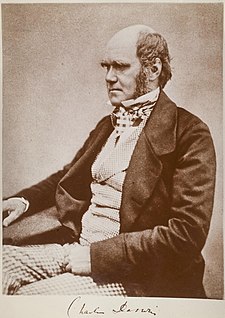
Darwin used the term twice in the 1859 first edition of his work On the Origin of Species, in Chapter IV: Natural Selection, and in Chapter VI: Difficulties on Theory –
Slow though the process of selection may be, if feeble man can do much by his powers of artificial selection, I can see no limit to the amount of change, to the beauty and infinite complexity of the co-adaptations between all organic beings, one with another and with their physical conditions of life, which may be effected in the long course of time by nature's power of selection.
We are profoundly ignorant of the causes producing slight and unimportant variations; and we are immediately made conscious of this by reflecting on the differences in the breeds of our domesticated animals in different countries,—more especially in the less civilized countries where there has been but little artificial selection.
Now, similar to my last blog about designer babies, at first I thought it was a fascinating concept with great potential, but after more research about the other side of the story, i realized that it might not be such a great idea. Natural selection causes animals to develop traits and characteristics that allow them to adapt to, and survive, their environment. In contrast, natural selection causes those animals to develop traits and characteristics that suit our needs rather
As owners of these animals and those who perpetuate this process, we have to be aware of the negative effects that it is having on these animals. We need to decide how much of a tradeoff is acceptable - how far are we willing to go to improve our lives, while having negative impacts on the animals that we are supposed to be taking care of? Let
me know what you think in the
comments section!
Sources
http://en.wikipedia.org/wiki/Artificial_selection
http://en.wikipedia.org/wiki/Charles_darwin
http://www.wisegeek.com/what-is-artificial-selection.htm
http://www.schoolnet.gov.mt/biology/evolution.htm


